
Tire Size Calculator Comparison
Enter your current tire size and the size you are considering. The calculator compares overall diameter, width, sidewall height, circumference and revolutions per mile, and shows how far off your speedometer will read.
- Free to use
- No sign-up
- Runs in your browser
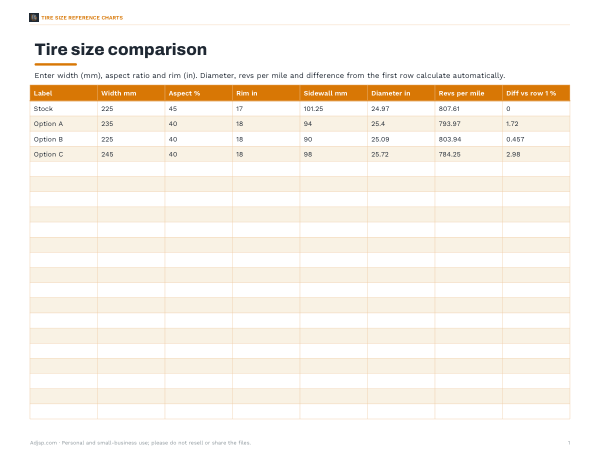
Compare tire sizes
Tire Size Reference Charts
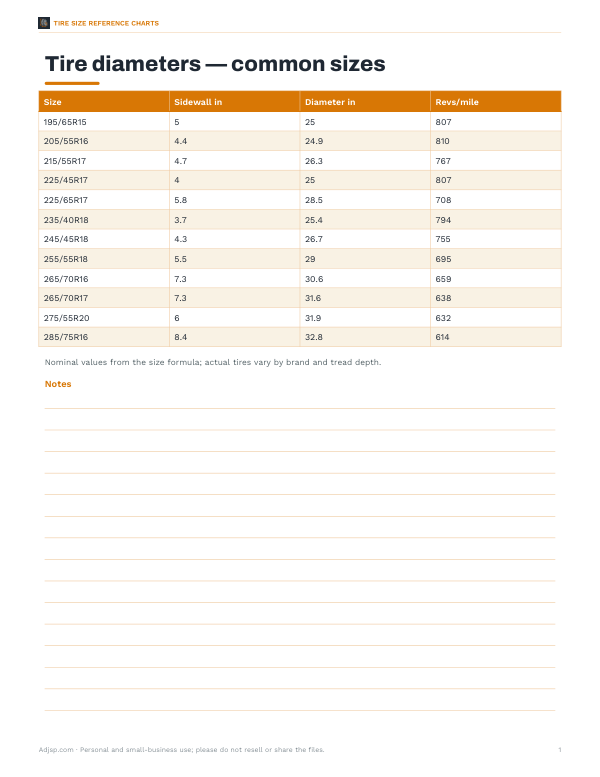
Printable diameter charts for common passenger and truck sizes, a plus-sizing guide and a tire comparison workbook.
- Tire comparison workbook (XLSX, PDF)
- Diameter reference chart (PDF, DOCX)
Formats: XLSX, PDF, DOCX. Instant download after payment (link valid 72 hours, up to 5 downloads). AI-assisted: the templates were drafted with AI help and reviewed and laid out before publishing.
$4.00 USD, one-time
- Instant download
- 7-day refund
- Secure checkout by Stripe
7-day money-back guarantee. Full refund within 7 days of purchase, even after you download.
Full refund within 7 days — see the refund policy and license.
Free printables
Single sheets you can print right now, no sign-up. The full pack adds every sheet in one download plus the editable files.
How to read a tire size
A metric tire size such as 225/45R17 is printed on the sidewall and tells you three dimensions. The first number is the section width in millimetres — 225 mm. The second is the aspect ratio: the sidewall height as a percentage of the width, here 45%, so the sidewall is about 101 mm tall. “R” means radial construction, and 17 is the wheel (rim) diameter in inches. A leading “P” marks a passenger tire and “LT” a light-truck tire. After the size you usually see the load index and speed rating, such as 91W, which the size comparison does not change.
The formulas
- Sidewall height = width × aspect ratio ÷ 100 (in mm).
- Overall diameter = rim diameter × 25.4 + 2 × sidewall height (in mm).
- Circumference = π × diameter.
- Revolutions per mile = 1,609,344 mm ÷ circumference.
- Actual speed = speedometer reading × new diameter ÷ original diameter.
The calculator works in millimetres for accuracy and converts to inches for display. Real tires vary slightly from these nominal figures by brand, tread depth and inflation, so treat the results as close estimates.
The ±3% rule
A common guideline is to keep a replacement tire's overall diameter within about 3% of the original. Beyond that, the speedometer and odometer become noticeably inaccurate, the automatic transmission may shift at slightly different points, and electronic systems such as ABS, traction control and stability control — which compare wheel speeds — can be affected. A larger tire can also rub on suspension parts or the wheel arch at full steering lock or under compression. Your vehicle manufacturer's placard, usually on the driver's door jamb, and the owner's manual list the approved sizes.
Speedometer error explained
Your speedometer counts how fast the wheels turn, not how fast you travel. A taller tire covers more ground per revolution, so you are going faster than the speedometer shows; a smaller tire makes the speedometer read high. In the example of 225/45R17 to 235/40R18, the new tire is about 1.1% taller, so at an indicated 60 mph you are doing about 60.7 mph. Many dealers and tuning shops can recalibrate the speedometer if you change size significantly.
Plus sizing
Plus sizing means fitting a larger wheel with a lower-profile tire so the overall diameter stays about the same. Going from 17-inch to 18-inch wheels is “plus one”. Because the wheel grows by 25.4 mm in diameter, the sidewall must shrink by about 12.7 mm on each side, which usually means a wider tire with a lower aspect ratio.
| Size | Wheel | Sidewall | Overall diameter |
|---|---|---|---|
| 205/55R16 | 16 in | 4.44 in | 24.9 in |
| 225/45R17 | 17 in | 3.99 in | 25.0 in |
| 225/40R18 | 18 in | 3.54 in | 25.1 in |
| 235/35R19 | 19 in | 3.24 in | 25.5 in |
Lower-profile tires sharpen steering response but ride more firmly, are more easily damaged by potholes, and usually cost more to replace.
Other things to check before changing size
- Load index: the new tire must carry at least the load rating specified for your vehicle.
- Speed rating: keep the same or a higher speed rating.
- Wheel width: each tire width fits a range of rim widths; a wider tire may need a wider wheel.
- Clearance: check the inner wheel arch, suspension and brake calipers, especially with wider tires or different wheel offset.
- Matching: fit the same size on each axle, and on all four wheels for all-wheel-drive vehicles unless the manufacturer specifies a staggered setup.
- Insurance and inspection: in some regions, non-standard sizes must be declared or approved.
Worked example
Comparing a stock 265/70R16 truck tire with a 285/75R16: the stock tire's sidewall is 185.5 mm and its diameter 777 mm (30.6 in); the larger tire has a 213.75 mm sidewall and 834 mm (32.8 in) diameter. That is 7.3% taller — well beyond the 3% guideline — so at an indicated 60 mph the truck travels at about 64.4 mph, revolutions per mile drop from about 659 to 614, and a lift or trimming may be needed for clearance.
Reading the rest of the sidewall
Besides the size, the sidewall carries the load index and speed rating (for example 94V, where 94 corresponds to a maximum load of 670 kg per tire and V to 240 km/h), the DOT code with the week and year of manufacture in its last four digits, the maximum inflation pressure (not the recommended pressure, which is on the vehicle placard), and markings such as M+S for mud and snow or the three-peak mountain snowflake symbol for severe snow performance. When comparing sizes for a replacement, match or exceed the original load index and speed rating.
Frequently asked questions
Can I put 235 tires instead of 225?
Often yes, if the overall diameter stays within about 3%, the rim width suits the tire and there is clearance. Check your vehicle's approved sizes.
Do bigger tires make the speedometer read slow?
Yes. A taller tire means you are travelling faster than the speedometer shows.
What does the aspect ratio mean?
It is the sidewall height as a percentage of tire width. 45 means the sidewall is 45% as tall as the tire is wide.
Does this work for LT and flotation sizes?
It supports metric sizes such as LT265/75R16. Flotation sizes like 33x12.50R15 already state the diameter (33 in).
Is 3% an official limit?
It is an industry guideline, not a law. Vehicle manufacturers and local regulations may be stricter.
Does a taller tire change fuel economy?
It can. Larger, heavier or wider tires usually add rolling resistance and weight, and the odometer under-reads, so logged MPG looks better than reality.
Why do revolutions per mile matter?
Some vehicles and all-wheel-drive systems use them to calibrate speed and traction systems; mixing tires with different revolutions per mile can strain an AWD transfer case.